North, imperial cities
Meknes and Volubilis
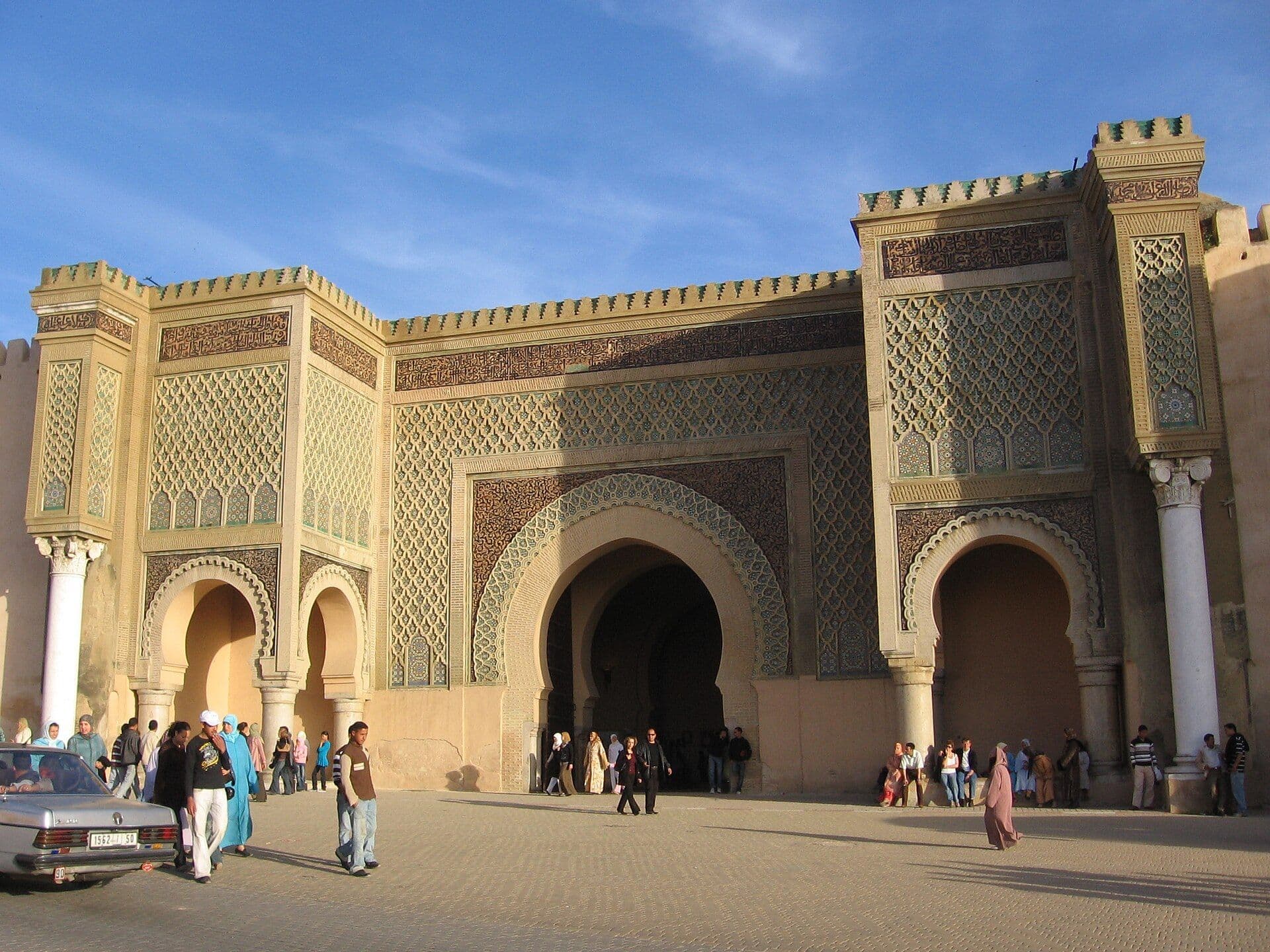
Meknes, the quietest imperial city, with the Bab Mansour gate and Moulay Ismail's stables, and Volubilis, the Roman town with mosaics in open fields.
- Region
- North, imperial cities
- From Marrakesh
- Meknes about 5 hours by car from Marrakesh, 1 hour from Fes; Volubilis 30 minutes from Meknes
- Best time
- March through June and September through November; Volubilis in spring among the flowers
Do not miss
- Bab Mansour, the gate of green zellige and marble columns
- The royal stables and granaries of Moulay Ismail
- A medina without tourists and without pressure
- The Roman mosaics of Volubilis in the open landscape
- The holy town of Moulay Idriss on the hill
- Vineyards and olive groves around the city
Meknes is the imperial city everyone skips, and that makes it the most pleasant one. Sultan Moulay Ismail made it his capital in the late seventeenth century, with forty kilometers of walls, stables for twelve thousand horses and the gate of Bab Mansour. Then power moved to Fes and Rabat, and Meknes was left behind as a quiet provincial town with a medina where you can simply walk around. Half an hour's drive away is Volubilis, a Roman town in open fields, with mosaics still lying where they were laid.
Meknes
Bab Mansour is the reason to come to Meknes. It is a monumental gate from 1732, covered in green zellige and with marble columns taken from Volubilis. You look at it from Place el-Hedim, the square across from it. In the evening the food stalls open there as they do on Jemaa el-Fna, but without the crowds.
Behind the gate lies the imperial city of Moulay Ismail. Here you find his mausoleum, which is open to everyone and has a quiet courtyard, and the enormous granaries and stables of Heri es-Souani, with their vaults and the Agdal basin next to them. The scale is hard to grasp; this was built to feed an army.
The medina of Meknes is small, and people simply live and work there. The Bou Inania Madrasa (yes, the same name as the one in Fes) has a roof you are allowed onto, with a view over the green roofs of the city. At the market by Place el-Hedim you buy olives in twenty varieties. The area around Meknes grows olives and wine grapes.
Volubilis
Volubilis lies on a slope among wheat fields, with a view of the Rif hills. In the third century it was a Roman town of twenty thousand people, and little has been built over it since. You walk along the decumanus maximus, the main street, past the triumphal arch of Caracalla, the basilica and the remains of villas whose floors are still intact. There you find mosaics of Orpheus, Bacchus and the labors of Hercules, right out in the open air. Storks nest on the columns.
Hire a local guide at the entrance. Without explanation it is a field of stones; with it, it is a city. Allow an hour and a half. In spring the fields are full of poppies.
On the hill next to it is Moulay Idriss Zerhoun, the small town around the tomb of the founder of the first Moroccan dynasty. It is a place of pilgrimage. Non-Muslims may now enter the alleys, but not the mausoleum. The view from the terraces at the top is worth the climb.
As a woman in Meknes, Volubilis and Moulay Idriss
Meknes and Volubilis are calm. In the medina of Meknes nobody approaches you; there are hardly any tourists and so no vendors waiting for you either. Volubilis is an open site with other visitors and guides, where there is nothing you need to watch out for. In Moulay Idriss covered clothing really is necessary: long sleeves and a long skirt or pants. The guides on what to wear and language and etiquette go into more detail.
Travel times and planning the day
Meknes is a five-hour drive from Marrakesh, an hour from Fes and two and a half hours from Rabat. Volubilis is half an hour north of Meknes. Set aside half a day for Meknes, an hour and a half for Volubilis and an hour for Moulay Idriss. Together that makes a full day, which you usually combine with the drive from Rabat to Fes.
The best months are March through June and September through November. In summer Volubilis is scorching and there is no shade; go early then. Bring a cap or scarf, sunscreen, water and good shoes for the uneven stones of Volubilis. The rest is on the packing list.
The day between Rabat and Fes
On the imperial cities tour this is the day between Rabat and Fes: Meknes in the morning, Volubilis and Moulay Idriss in the afternoon, arrival in Fes in the evening. Soukayna drives, arranges the guide at Volubilis and knows where to eat well in Meknes without a tourist menu. If you would rather spend the night in Meknes than in Fes, because it is quieter, that is possible too.
Questions about Meknes and Volubilis
Is Meknes worth it if I am already visiting Fes?
Yes, because it is the opposite of Fes. Meknes is calm and easy to navigate, and no vendors follow you around. Half a day is enough. Combine it with Volubilis on the way to Fes.
How much time do I need for Volubilis?
An hour and a half to two hours. The site is large and open, and the mosaics are outdoors. Go early in the morning or at the end of the afternoon, because there is no shade in the middle of the day.
Am I allowed to visit Moulay Idriss?
Yes. The town was closed to non-Muslims for a long time, but it is open now. You can't go into the mausoleum itself; the alleys and the view from the terraces are open to you. Wear covered clothing.
Can I take the train from Meknes?
Yes. Meknes is on the line that connects Fes, Rabat and Casablanca. Fes is forty minutes away.
Trips to Meknes and Volubilis
Other destinations
Shall we plan your trip together?
Send a message with when you want to go, who you are traveling with and what appeals to you. You get a proposal back and you are not committed to anything.
You chat with Soukayna (English, French, Moroccan Arabic) or Bas (Dutch).